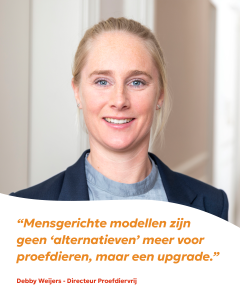
"Human-centered models are no longer 'alternatives' to laboratory animals, but an upgrade"
“Jaarlijks worden in Nederland nog honderdduizenden dieren gebruikt voor de wetenschap. Tegelijk weten we steeds beter dat dierproeven vaak een omweg zijn: we proberen de mens te begrijpen via dieren, terwijl er inmiddels modellen zijn die veel dichter bij de mens staan. Er liggen nog grote kansen dit probleem aan te pakken. We volgen nog steeds een route die eigenlijk niet meer logisch is,” legt Debby Weijers, Directeur Proefdiervrij uit.
“Mensgerichte modellen sluiten direct aan op de mens en maken complexer onderzoek mogelijk – ze vormen zo een veel logischere route”. Dat is niet alleen beter voor dieren, maar ook veel logischer voor onderzoek dat uiteindelijk mensen moet helpen.”
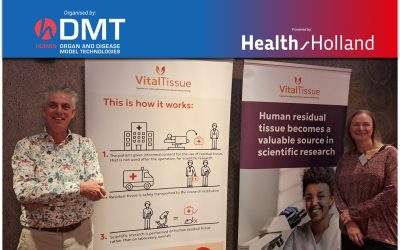
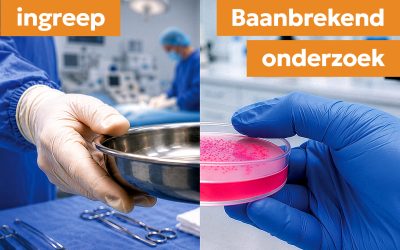
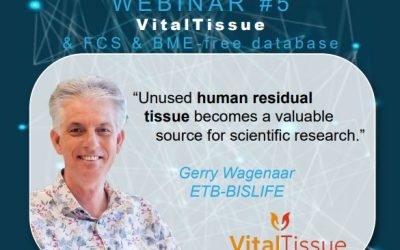
“Residual tissue provided through VitalTissue is an excellent resource for many of these human-centered models, such as organ-on-a-chip or organoid models. Residual tissue is, by far, the closest to the system we want to study: the human body. And to think it would otherwise be discarded! For me, VitalTissue is truly a 'one plus one equals three' project. That is why Proefdiervrij has invested 200,000 euros in VitalTissue to support this animal-free progress. This way, we advance human-centered science: in a concrete, applicable way, and reducing reliance on animal tests.”
“We want people to spread the word that human-centered models are the future—whether at the dinner table, in the lecture hall, or in the lab. Because the more people understand that animal testing still takes place, but has become a detour, the faster we can build a new standard together.”
See also: https://proefdiervrij.nl/tijd-voor-menselijkheid